Understanding Load Capacity: How
QWQER Has the Right Vehicle for Every
Load
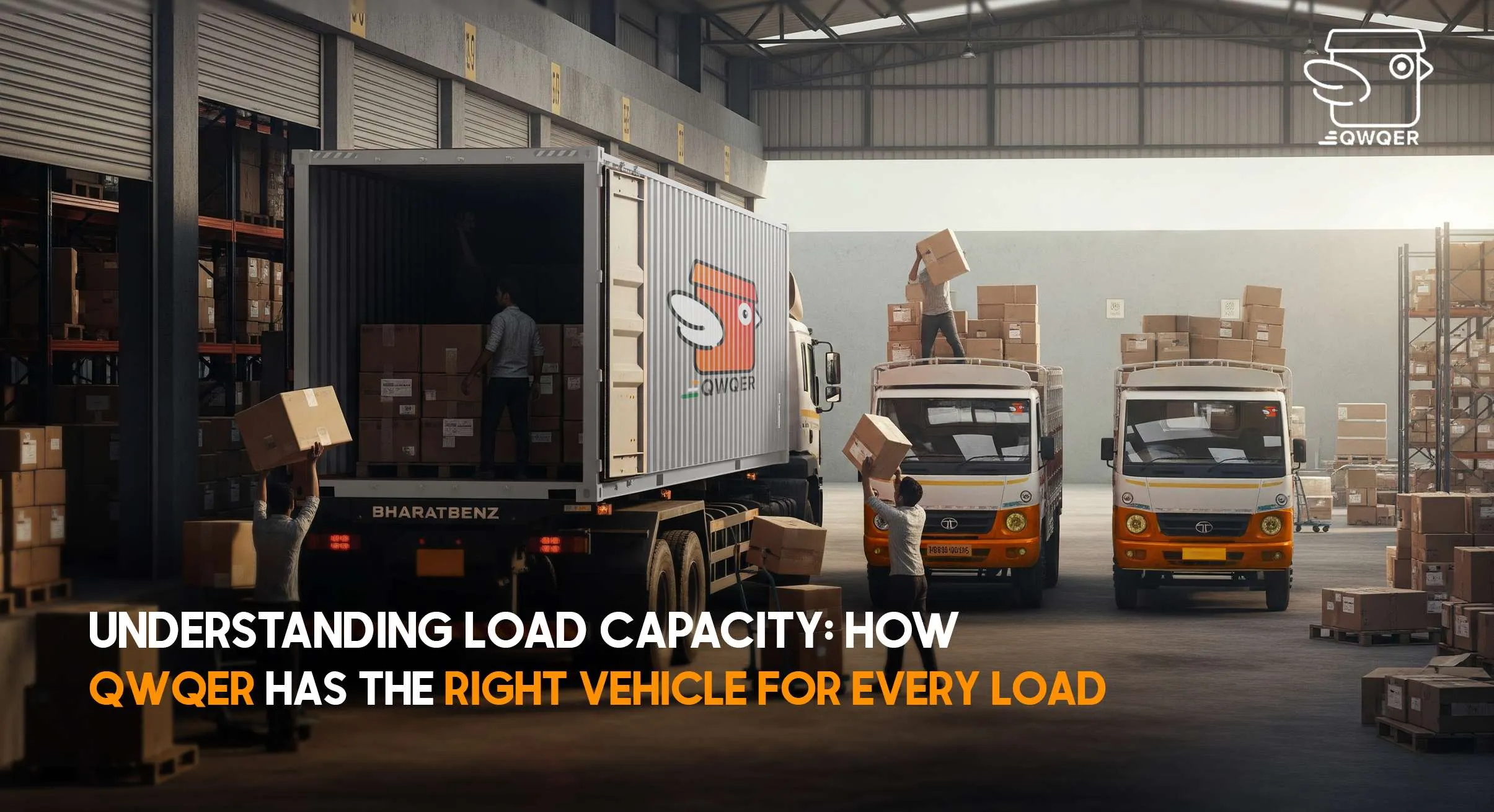
No matter what your business or how heavy your load, QWQER has the
perfect vehicle to match your needs. From nimble two‑wheelers and compact
three‑wheelers to versatile pickup trucks, enclosed LCVs, and heavy‑duty
tippers or trucks, our fleet scales with your business—whether you’re moving
a few parcels across town or hauling multiple tonnes between cities. With
QWQER, you get the right truck, every time, so you can keep costs down,
stay compliant, and deliver with confidence.
When it comes to transporting goods—whether you’re a small e‑commerce
merchant, a local builder, or a large logistics operation—knowing your truck’s
load capacity is non‑negotiable. Underestimating how much you can safely
carry doesn’t just risk fines or equipment damage; it can put lives on the line,
increase fuel consumption, and inflate your operational costs. Conversely,
using a vehicle that’s oversized for your cargo needs can be equally
inefficient. In this blog, we’ll walk you through everything you need to know
about matching your cargo to the right truck, so you can save money, stay
compliant, and sleep easy knowing your load is safe.
Common Pitfalls of Underestimating or Overloading
- Safety hazards
Overloading increases braking distance, destabilizes steering, and
heightens rollover risk.
- Regulatory fines & delays
Exceed weight limits, and you may face hefty penalties or be forced to
unload at the roadside.
- Equipment wear & tear
Chassis, suspension, and tires wear out faster under constant overload.
- Higher fuel costs
Extra weight means more engine effort—and more diesel at the pump.
- Operational inefficiency
An under‑loaded heavy truck burns just as much fuel as a full one,
meaning you pay more per cargo ton.
What You’ll Learn
By the end of this post, you’ll be able to:
1. Define gross vehicle weight rating (GVWR) and payload capacity.
2. Identify how factors like chassis design and road rules affect what you
can carry.
3. Choose the right truck class for your item’s size, shape, and weight.
4. Calculate volumetric (“cube”) vs. actual weight limitations.
5. Implement best practices for secure, balanced, and safe loading.
What Is Load Capacity?
GVWR vs. Payload Capacity
- Gross Vehicle Weight Rating (GVWR)
The absolute maximum weight of the truck plus everything on
it—including driver, fuel, cargo, and attachments.
- Payload Capacity
The maximum weight of cargo alone that the truck can carry, calculated
as
PayloadCapacity=GVWR−(CurbWeight+Driver+Fuel+Accessories)Paylo
ad Capacity = GVWR − (Curb Weight + Driver + Fuel +
Accessories)PayloadCapacity=GVWR−(CurbWeight+Driver+Fuel+Acce
ssories).
How Specs Are Determined
Manufacturers conduct stress tests on frame, suspension, brakes, and axles.
Regulatory bodies (e.g., RTO in India) then certify GVWR to ensure
public-road safety standards.
Why Both “Volume” and “Weight” Matter
- Volume (m³)
You might “cube out” (run out of space) before you “weigh out.”
- Weight (kg)
You might “weigh out” before you “cube out” if the cargo is very dense.
Key Factors That Affect Load Capacity
1. Chassis & Suspension Design
Heavier-duty springs and reinforced frames boost capacity but add curb
weight.
2. Axle Count & Configuration
More axles distribute weight better, allowing higher GVWR with fewer
penalties.
3. Body Type
- Flatbed vs. Container vs. Tipper each have different structural
limits.
4. Regulatory Limits
- Permits may be needed for oversize/overweight loads.
- Road restrictions vary by route, time of day, and local
enforcement.
Light‑Duty Vehicles
Motorbikes & Scooters
- Typical Payload: 30–50 kg
- Ideal For: Small parcels, documents, time‑sensitive courier runs.
- Pros: Low cost per run; nimble in traffic.
- Cons: Extremely limited weight & volume; weather‑sensitive.
Three‑Wheelers (Auto‑rickshaws)
- Typical Payload: 200–300 kg
- Ideal For: Micro‑deliveries in narrow lanes or dense urban zones.
- Pros: Better payload than bikes; compact footprint.
- Cons: Slower highway speeds; limited security for freight.
Medium‑Duty Trucks
Mini Trucks / Pickups (e.g., Tata Ace, Mahindra Jeeto)
- Payload Range: 600–1,200 kg
- Common Use‑Cases: Small furniture pieces, household appliances,
small-volume bulk (e.g., grains).
- Pros: Low operating cost; versatile.
- Cons: Limited to 1–2 pallets; height restrictions for large items.
Light Commercial Vehicles (LCVs)
- Payload Range: 1,200–3,000 kg
- Use‑Cases: Multi‑stop courier runs, light palletized goods (auto parts,
FMCG).
- Pros: Can carry 3–5 pallets; enclosed bodies protect against weather.
- Cons: Higher fuel consumption than mini‑trucks; parking can be tricky in
tight zones.
Heavy‑Duty Trucks
Medium Trucks (14–20 ft Body)
- Payload Range: 3,000–7,000 kg
- Ideal For: Large furniture, bulk commodities (rice, cement), pallet loads
(12–18 pallets).
- Pros: Balance of volume & weight capacity; suited for intercity routes.
- Cons: Requires skilled drivers; higher tolls & route restrictions may
apply.
Specialized Truck Bodies & Their Capacities
Body TypeTypical PayloadBest ForTipper TrucksUp to 15,000 kgBulk
aggregates (sand, gravel), demolition wasteContainer TrailersUp to
25,000 kgLong‑haul intermodal, standard 20 ft & 40 ft containersReefer
Trucks8,000–12,000 kgTemperature‑controlled perishables (dairy,
pharma)Flatbeds & Platform TrucksUp to 15,000 kgOversized machinery,
building materials, pipes
Volume vs. Weight: When One Limits You
- Calculating Cubic Capacity
Length×Width×Height(inmetres)=m3Length × Width × Height (in metres)
= m³Length×Width×Height(inmetres)=m3
- Weigh‑Out vs. Cube‑Out
- Weigh‑out: reach weight limit before filling volume.
- Cube‑out: fill volume limit before reaching weight.
- Practical Tip:
Use a simple spreadsheet (or our interactive calculator) to compare m³
demand vs. kg demand—and pick the truck whose lower utilization
percentage wins.
Tools & Tips for Accurate Volumetric Calculations
1. 3D Measuring Apps
Scan your cargo to get exact dimensions.
2. Load Planning Software
Many TMS platforms show real‑time utilization bars for both weight and
volume.
3. Mobile Scales & Pit Scales
Quick checks before departure to confirm actual loaded weight.
Tips for Maximizing Safe Load Usage
1. Proper Load Distribution
- Keep heavy items near the axle.
- Maintain a low center of gravity.
2. Securing Cargo
- Use ratchet straps for high-tension holds.
- Fill voids with dunnage—wood blocks or airbags.
- Nets and tarps protect from shifting and weather.
3. Pre‑Trip Inspections & Weight Verification
- Check tire pressures (proper inflation improves load rating).
- Weigh at certified scales—document the ticket for audits.
4. Driver Training
- Make sure operators understand load charts and safe driving
speeds under load.
Conclusion & Next Steps
Choosing the right vehicle for your cargo is both an art and a
science—balancing weight, volume, regulatory compliance, and cost. By
understanding GVWR vs. payload, factoring in chassis design and road rules,
and leveraging load‑planning tools, you can:
- Reduce safety risks and insurance claims
- Optimize operating costs per kilometre and per kilogram
- Improve delivery times by avoiding roadside weight inspections
Ready to put theory into action? Try QWQER, where you can enter your exact
cargo dimensions and weight to get instant vehicle recommendations, live
pricing, and API integration options.
Can I exceed payload if volume allows?
No—payload capacity is non‑negotiable. Exceeding it can lead to fines,
equipment damage, and safety hazards.
How often do payload specs change?
Manufacturers update GVWR when there are major frame or suspension
revisions—typically every new model cycle (2–4 years).
Does QWQER help arrange special permits for oversize or overweight loads?
Yes. We offer a permit‑arrangement service to handle route surveys and
documentation so you stay compliant on every trip.